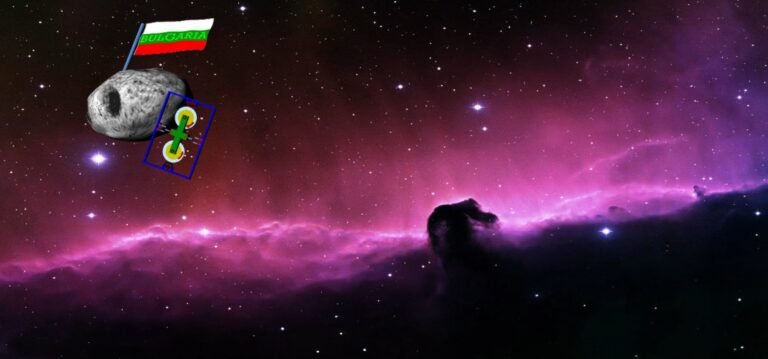
According to classical mechanics, as a consequence of Newton's three laws, the momentum of two (or more) bodies in a closed inertial system is always zero, regardless of the interactions between the bodies. Thus, the center of mass of the closed system (regardless of the interactions between the bodies) remains at rest or continues its inertial motion, i.e., the law of conservation of the center of mass motion of the closed system is in effect. This is an experimental fact described by Newton in The Principia Mathematical Principles of Natural Philosophy [1], see Corollary 3 and Corollary 4 on pages 420 and 421. Therefore, we can achieve spacecraft propulsion in outer space by means of a jet engine and the application of Newton's third law, as the propellant escaping through the nozzle under pressure creates thrust in the opposite direction of the exiting gases, in accordance with the law: For every action, there is an equal and opposite reaction.. Thus, spacecraft propulsion is associated with a constant propellant expenditure, making them inefficient in terms of propellant usage. The problem is that propellant intended for later use must be factored in as payload on the spacecraft, which is accelerated every time along with the actual payload, and is used only once during a specific period of the space mission.
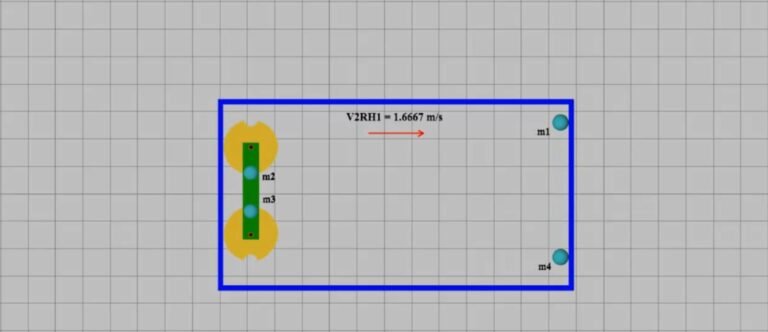
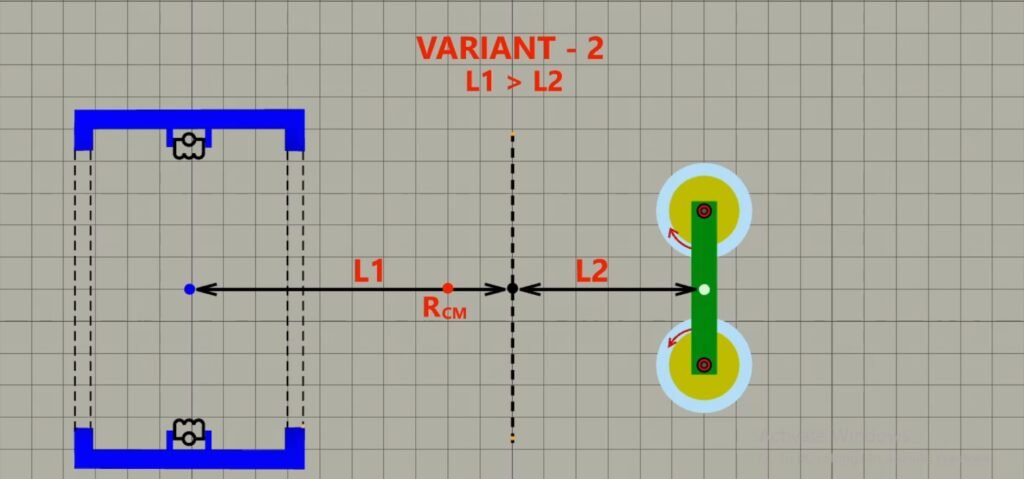
This book examines a special case of the law of conservation of momentum of the center of mass of a closed inertial system – a two-body device – TBD (two hulls). As in this particular case, we get an uncompensated impulse – UCM for one housing of the device. The conditionally named first housing is a standard classical body. While the second housing consists of two disks of equal mass, attached to the second housing, but in such a way that they can rotate freely relative to it. When Newton's third law is applied between the two housings, the inertia of the two disks (which rotate in opposite directions) is used. In this way, since kinetic energy is an additive quantity, the housing with the disks distributes its energy for both the rotational movement of the disks and the translational movement of the second housing. (See ANIMATION-1 [7], where the processes under consideration are visually shown, as well as at an alternative address in YouTube .)
While for the first body, all kinetic energy, due to the applied third law, is in the form of translational motion. As a result of the energy distribution of the second body, we get an uncompensated impulse for the first body. As a result, we also get a special case of the law of conservation of momentum of the center of mass of a closed system – a device consisting of two bodies. In this way, we have the possibility of specific propellantless propulsion of the device in outer space. Despite some disadvantages of the specific propulsion obtained in this way, it is one of the possible ways of propulsion in outer space without „ejecting“ propellant (without propellant consumption), but only by using electrical energy from photovoltaics or nuclear energy.
E-mail: propulsion@ldg2.com